
Is Sintered Stone Indestructible? The Truth About Heat and Scratches
- stonehubsg
- Apr 30
- 3 min read

If you’ve recently visited a kitchen showroom in Singapore, you’ve likely encountered sintered stone. This material is the current superstar of the interior design world, frequently advertised as the "forever" surface. Fabricators often boast that it can handle scorching pans, repel aggressive knives, and withstand the harshest household chemicals.
But is sintered stone truly indestructible, or is this just clever marketing? To find the truth, we must look at the incredible science behind its creation—a process that mimics the Earth’s natural power on an accelerated timeline.

Nature’s Recipe, Perfected by Tech
Imagine the forces that created granite or marble over millions of years: extreme pressure and colossal heat. Sintering is the technological replication of this metamorphic process.
It starts with raw minerals—the same components found in granite and porcelain, like quartz and silica—which are ground into a fine powder. This mixture is then subjected to:
Extreme Pressure: The powder is compacted under a force often exceeding 25,000 tons, removing all air pockets.
Extreme Heat: The slab is fired in a kiln at temperatures exceeding 1200°C.
In nature, this takes eons. In a factory, it takes minutes. The result is a non-porous, ultra-compact material that is almost as hard as diamond.
The Truth About Heat: A Champion of Resiliency
When homeowners ask about heat resistant countertops, sintered stone is the gold standard.
Because it was forged in a 1200°C kiln, it is fundamentally immune to typical kitchen heat. You can place a piping hot tray straight from the oven or a boiling pot off the stove directly onto the surface. Unlike quartz (which uses resin binders that can scorch) or laminate (which melts), sintered stone will not burn, discolor, or crack due to localized heat. For the heavy-duty cooking common in Singaporean kitchens, this is a genuine game-changer.
The Truth About Scratches: An Impressive Defense
The search for a scratch proof stone often ends here. Sintered stone typically ranks 7 or 8 on the Mohs scale of mineral hardness.
Under normal conditions, it is practically scratch-proof. You can prepare food directly on the surface or drag heavy ceramic cookware across the counter without a second thought. Steel knives won't leave a mark. However, "indestructible" is a strong word. While steel won't scratch it, a harder material—like a diamond-tipped tool or specialized ceramic blades—technically could if enough force is applied.
The Achilles' Heel: The Truth About Chipping
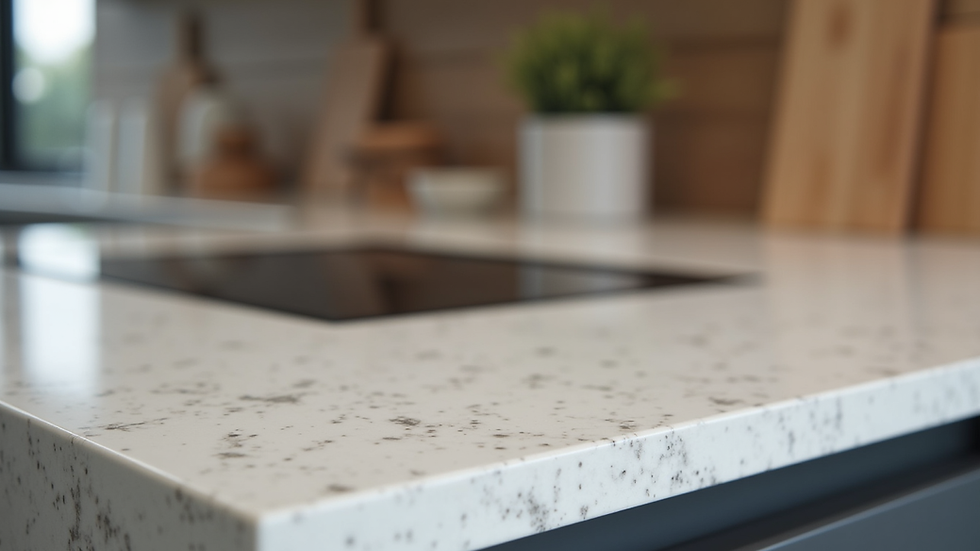
While it is nearly impossible to burn or scratch the surface, sintered stone does have one notable vulnerability: its edges.
Because the material is ultra-compact and incredibly hard, it is also inherently "brittle." It lacks the internal "flex" that resin-heavy materials like quartz possess. If a heavy cast-iron skillet or a stone pestle is accidentally slammed against the sharp 90-degree edge of the countertop, the stone can chip.
To mitigate this, most experts in Singapore sintered stone installation recommend specific edge profiles:
Rounded or Bullnose Edges: Softening the sharp angle into a curve helps distribute the force of an impact, significantly reducing the risk of a chip.
Mitred Aprons: These provide a thick, luxurious look while shielding the most vulnerable points of the slab.
The Verdict: Built for Real Life
So, is sintered stone indestructible? Technically, no. Like any high-end material, it can be damaged by extreme edge impacts or specialized abrasives.
However, is it the closest thing to an indestructible surface for the modern home? Absolutely. In terms of daily performance, it offers an unmatched level of resistance to heat, scratching, and staining. If you treat the edges with just a little bit of common sense, your sintered stone countertop will likely look as pristine in ten years as it does on the day of installation.


Comments